Palıt
University
Everything you need to understand crypto, from the basics to staying safe. Learn at your own pace.
What You'll Learn
Your Crypto Curriculum
Short, practical lessons designed for anyone — no prior experience needed.


Introduction to
Cryptocurrency
Cryptocurrency is a form of digital money secured by cryptography — the science of encoding information. Unlike the peso or dollar, no government or central bank issues or controls it.
The first and most well-known cryptocurrency, Bitcoin, was created in 2009 by an anonymous person known as Satoshi Nakamoto. Today, thousands of cryptocurrencies exist, each with different features and use cases.
Transactions are recorded on a public ledger called a blockchain, making them transparent and nearly impossible to fake or reverse.
- Decentralized — no single authority controls it
- Transparent — all transactions are publicly viewable
- Borderless — send money anywhere in the world instantly
- Scarce — most cryptocurrencies have a fixed maximum supply
What is a
Blockchain?
A blockchain is a shared digital ledger — like a spreadsheet maintained simultaneously by thousands of computers worldwide. Every time someone sends cryptocurrency, that transaction is added as a new "block" chained to all the ones before it.
What makes it powerful: once a transaction is recorded, it cannot be changed or deleted. Altering one block would break the cryptographic link to every block that follows.
No single company, government, or person owns the blockchain. It's maintained by a distributed network of computers that all agree on what's true.
- Immutable — records can never be altered after the fact
- Distributed — no central point of failure or control
- Permissionless — anyone can participate and verify
- Transparent — every transaction is publicly visible
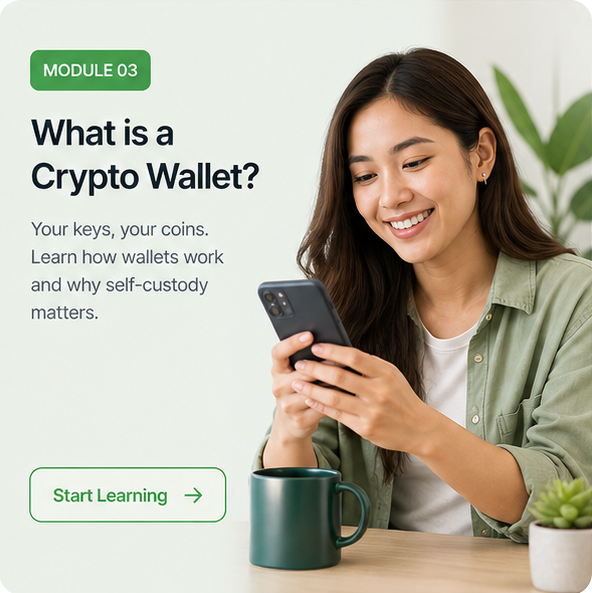
What is a
Crypto Wallet?
Contrary to the name, a crypto wallet doesn't store your coins. Your assets live on the blockchain. What a wallet stores are your private keys — the cryptographic passwords that prove ownership and authorize transactions.
Think of the blockchain as a transparent vault everyone can see into. Your private key is the only combination that opens your box. Lose the key and you lose access — permanently.
Palit is a non-custodial wallet. Only you hold your private keys. Unlike centralized exchanges, Palit never controls your assets — you always do.
- Public key = your wallet address (safe to share)
- Private key = your password (NEVER share this)
- Non-custodial = you own your keys, you own your crypto
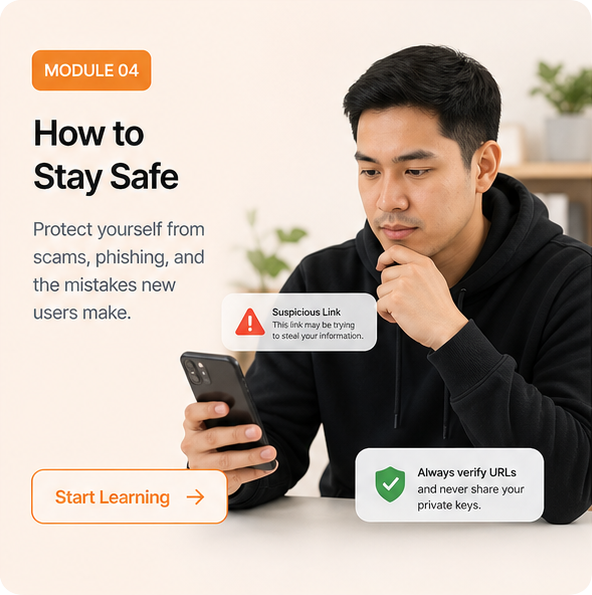
How to Stay
Safe
Crypto's decentralized nature is its biggest strength — and its biggest risk. There's no bank to call if you're scammed, no customer service to reverse a transaction. Security is entirely your responsibility.
The golden rule: "Not your keys, not your crypto." If you don't control your private keys, someone else does — and that's a risk you shouldn't accept.
Scams are sophisticated and relentless. Common attacks include fake airdrops, support impersonation, phishing websites identical to real ones, and investment fraud promising impossible returns.
- Blockchain transactions are irreversible — think twice before sending
- If it sounds too good to be true, it's a scam — no exceptions
- DYOR — Do Your Own Research before any investment
Crypto Glossary
Quick definitions for every crypto term you'll encounter.
Crypto Quiz
7 questions. See how much you've learned.
Ready to put your
knowledge to work?
Start with Palit.
Open your free non-custodial wallet in minutes.